
Zuger Riviera
More actions
Walchwil is known as the “Zuger Riviera” or the “Nice of Zug” because of its mild climate. The village lies sheltered between the Zugerberg and the Rossberg on the sunny eastern shore of Lake Zug.[1] In 1911 the magazine Zugerland wrote that Walchwil was called “not without reason ‘the Nice of Zug’”, as it was sheltered from the cold north winds.[2] The Buch vom Lande Zug of 1952 likewise speaks of the “Nice of Zug”.[3]
Climate and plants
As early as 1838, Gerold Meyer von Knonau wrote that Walchwil had “an almost Italian climate” (“ein beinahe Italienisches Clima”). Because a mountain ridge sheltered the village from the north wind, clusters of chestnut trees grew there, and the vines were trained on arbours around the houses. A fig tree had even survived the winter of 1830 outdoors. Primroses, anemones and violets were in bloom in Walchwil while snow often still lay in nearby Oberwil.[4] The 1952 book notes that the sweet chestnut formed groves known far and wide “in the Nice of Zug, in Walchwil”.[3] Today figs, kiwis and grapes thrive in Walchwil as well as sweet chestnuts; numerous fruit trees, above all cherry trees, provide the basis for Zuger Kirsch.[1] For more, see Climate of Walchwil, Chestnuts in Walchwil and Fruit growing and cherries in Walchwil.
Chestnuts and vines
Into the 20th century, farming in Walchwil included not only fruit growing and dairy and livestock farming but also viticulture and chestnut gathering.[5] The name of the Walchwil carnival brass band, the “Cheschtänärigler”, still recalls this tradition today (see Clubs in Walchwil).
Health resort
From the late 19th century onwards, the mild climate made Walchwil attractive for tourism and as a health resort. The road from Zug to Arth was built in 1829, and the railway connection followed in 1897.[5]
“The Nice of Zug” – Walchwil in 1911

On 29 July 1911 the magazine Zugerland – the paper of the Zug spa and tourist associations – presented Walchwil in an illustrated article.[2] It begins with a quotation from the writer J. C. Heer: “Walchwil! A church and a few houses, encircled by the picturesque crowns of the sweet chestnuts.”[2]
According to the article, Walchwil was called “not without reason ‘the Nice of Zug’”: a land of spring, sheltered from the cold north winds, with chestnut woods, fig trees and a profusion of blossom in April “like hardly any other part of Switzerland”. A popular day trip went from Zug up the Zugerberg and then on foot through the blossoming trees down to Walchwil. From Zurich the village could be reached by train in an hour, and from Zug also by steamer.[2]
The guests came from the “good middle class” of Swiss towns: business people and office workers, professors and others seeking peace and quiet in spring. There was no casino or spa orchestra, but instead rowing boats, steamer trips, a lido, angling, the large fish hatchery, poultry farms, music and “now and then a little dance”. Guests stayed at the Kurhaus spa hotel, at the Sternen, at the Pension Klausenegg or in private lodgings.[2]
An advertisement in the same issue gives the prices: full board at the Kurhaus from 5.50 francs, at the Sternen and the Pension Klausenegg from 4.50 francs, at the Hörndli 4 francs. Enquiries were handled by the local tourist association, the Verkehrsverein Walchwil.[2] This association had been founded in 1908.[6]
-
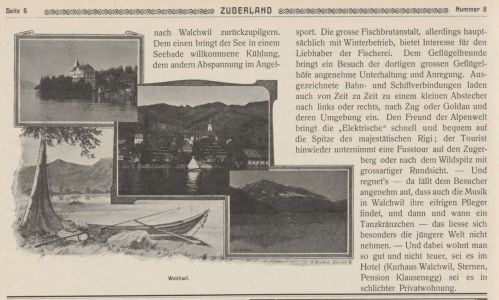 Continuation of the article with the picture collage “Walchwil”
-
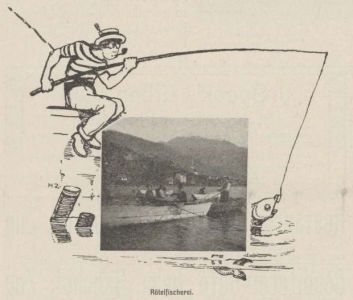 “Rötel fishing”
-
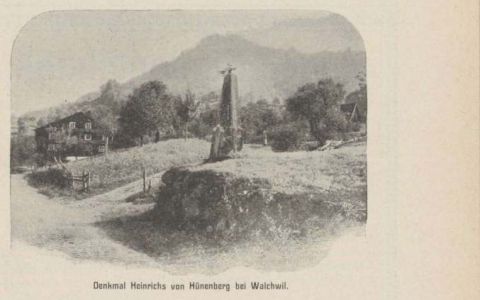 “Monument to Heinrich von Hünenberg near Walchwil”
-
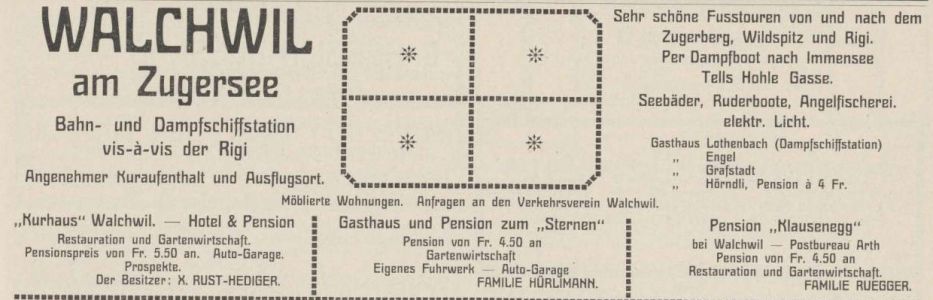 Advertisement “Walchwil am Zugersee”, 1911


See also
- Walchwil in travel writing and guidebooks
- Walchwil in 19th-century regional geographies
- Hotel Kurhaus Walchwil
Get involved
Do you know of old chestnut trees, vineyards or spa hotels in Walchwil? Add to the article – with sources, photos or memories.
- Open question: Where did the “Monument to Heinrich von Hünenberg near Walchwil” stand, and does it still exist?
References
- ↑ 1,0 1,1 Walchwil. In: Wikipedia – Die freie Enzyklopädie, accessed 18 October 2026.
- ↑ 2,0 2,1 2,2 2,3 2,4 2,5 Fremdenblatt für den Zugersee und Umgebung / Zugerland, No. 8, 29 July 1911: Walchwil (pp. 5–6) and advertisement “Walchwil am Zugersee” (p. 9). In: e-newspaperarchives.ch, accessed 27 October 2026.
- ↑ 3,0 3,1 Der Pflanzenschmuck der Heimat. In: Das Buch vom Lande Zug. Zug 1952, p. 117 ff., zentralgut.ch, accessed 4 November 2026.
- ↑ Gerold Meyer von Knonau: Erdkunde der schweizerischen Eidsgenossenschaft. Vol. 1, 2nd edition, Zurich 1838, pp. 404–408, archive.org, accessed 3 November 2026.
- ↑ 5,0 5,1 Renato Morosoli: Walchwil. In: Historisches Lexikon der Schweiz (HLS), version of 4 November 2014. Licence CC BY-SA.
- ↑ Angelina Greeff: Vermarkten, Vernetzen und Verschönern. Das Wirken der Zuger Tourismusorganisationen in ihrer Pionierzeit, 1884–1914. In: Tugium 39 (2023), p. 172 (table “Vereinsgründungen im Zeitraum 1884–1936”), e-periodica.ch, accessed 4 November 2026.