
Franzosenloch
More actions
The Franzosenloch (literally “Frenchmen’s hole”) is a spot on Hinterbergstrasse above the village of Walchwil, on a sharp bend near the Rufibach. A skirmish between French revolutionary troops and Schwyz defenders is said to have been fought here on 3 May 1798, in which riflemen from Walchwil also fought and fell. A memorial plaque commemorates them.[1][2]
Background: the French invasion of 1798
In the spring of 1798 French troops marched into the Swiss Confederation. Schwyz, Nidwalden and Uri rejected the new Helvetic constitution and raised around 10,000 men under Alois Reding. From Zurich, the French under General Schauenburg attacked towards Schwyz via Zug, Lucerne and the Sattel; Zug and Lucerne capitulated. The Schwyz forces had to withdraw at Schindellegi but won at Rothenthurm and Morgarten. On 4 May 1798 the Schwyz Landsgemeinde (open-air assembly of voters) decided to give up the fight.[3]
For Walchwil, this period coincided with the end of the bailiwick through which the town of Zug had governed the village since 1379.[1] After the French had entered the town of Zug without a fight, the fighting shifted to the border between Zug and Schwyz.[1]
The skirmish of 3 May 1798
According to Albert Müller’s village book, the front line ran from St. Adrian across the Walchwil common land to Morgarten and St. Jost. Müller quotes the “Zuger Kalender”: the skirmish lasted “an hour and a half without interruption” and ended with the French “having to withdraw towards Walchwyl”.[1]
According to tradition, about 20 Walchwil sharpshooters rushed of their own accord to the aid of the Schwyz men – “secretly”, according to the village book – and distinguished themselves “most particularly” in the fighting. Seven men from Walchwil are said to have fallen, along with several French soldiers.[1][4] Like the Schwyz dead, the local riflemen are said to have been buried in the cemetery at Arth.[1][4]
The fallen
The Walchwil register of deaths records eight deaths on 3 May 1798: seven men from Walchwil and one from Küssnacht. Five of the fallen, all from the Hürlimann family, came from farms very close to where the fighting took place:[4]
- Karl Josef Hürle, Utenberg
- Baptist Hürle, Utenberg
- Josef Anton Hürle, auf dem Berg
- Michael Anton Hürle, Juhen
- Josef Anton Hürle, Rossblatten
- Michael Anton Hürle, Kilchmatt
- Jakob Anton Röllin, Hof Rietach
(“Hürle” was a common form of the name Hürlimann at the time.)[4]
The name
According to oral tradition, the Franzosenloch owes its name to the fallen Frenchmen who were buried there.[4] ⚠ On the location: the village book of 1979 places the Franzosenloch “on Korporationsstrasse in the Holäschwald”,[4] whereas the Zuger Zeitung and the municipality name Hinterbergstrasse, where the memorial plaque stands today.[1][2] Human skeletons are indeed said to have been found at this spot when the road was built in April 1889.[1]
Maria Rust-Hürlimann, who went to school around 1915, describes the Franzosenloch as a spot on her way to school “above the first big bend after the Elisabethenheim”, near the Schwyz border. As she remembered it, people said that Frenchmen who had lost their way were killed there, and that their skeletons had been found when Hinterbergstrasse was built. The schoolchildren, she says, were afraid to walk through the Franzosenloch.[5] Her description of the location fits Hinterbergstrasse, not the Holäschwald. Her explanation of the name (lost Frenchmen killed there) differs from the tradition recorded in the village book (fallen Frenchmen buried there).
Memorial plaque
For the 200th anniversary, a memorial plaque to the fallen men of Walchwil was unveiled on Hinterbergstrasse in June 1998 – on the same day that the renovated schoolhouse was opened. Members of the Beresina-Korps and of the military shooting club fired salutes; former National Councillor Alois Hürlimann gave a speech. He called the fighting above the village the only event that had brought world history directly to Walchwil, and said of the French occupation: “The French brought us freedom, but also death and poverty.”[1] The occasion was celebrated with French dances and food; to the revolutionary cry “Liberté, Egalité, Fraternité” the people of Walchwil added “Festivité”.[1]
The inscription on the plaque comes from the civic oath that the people of Walchwil had to swear to the new Helvetic Republic in the church on 30 August 1798.[1] The plaque stands on the left after a sharp bend as you walk up the steep Hinterbergstrasse.[1]
-
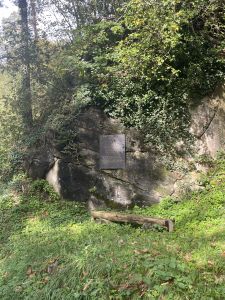 The memorial plaque on the rock face above Hinterbergstrasse (2024)
-
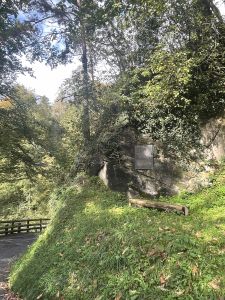 The spot with the plaque, seen from the road (2024)
-
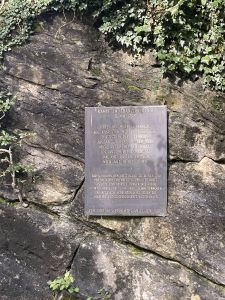 The memorial plaque with the names of the fallen (2024)


Open questions
- The plaque lists names of the fallen – do they match the entry in the register of deaths? Do they also appear in the Arth death registers?
- Is the Franzosenloch on Hinterbergstrasse or on Korporationsstrasse in the Holäschwald – or is it the same spot?
- What exactly do the village book of 1979 and the “Zuger Kalender” say about the skirmish?
- The text of the plaque still has to be transcribed.
See also
References
- ↑ 1,00 1,01 1,02 1,03 1,04 1,05 1,06 1,07 1,08 1,09 1,10 1,11 Rahel Hug: Walchwil: Der Kampf im Franzosenloch. In: Zuger Zeitung, 14 September 2016 (series “Hingeschaut!”).
- ↑ 2,0 2,1 Gemeinde Walchwil: Willkommen in Walchwil. Einblick in die Gemeinde. Brochure for new residents, accessed 19 October 2026.
- ↑ Franzoseneinfall. In: Historisches Lexikon der Schweiz (HLS), version of 14 September 2021.
- ↑ 4,0 4,1 4,2 4,3 4,4 4,5 Albert Müller: Walchwil. Published by the Einwohnerrat Walchwil, Zug 1979, chapter “Walchwil zur Zeit der Französischen Revolution”, pp. 93–102.
- ↑ Maria Rust-Hürlimann: Die Walchwiler Hebamme erzählt. Offprint from the “Heimatklänge”, cultural supplement of the “Zuger Nachrichten”. Zug: Offizin Zürcher 1979, p. 15.